

For years, Semaglutide (a GLP-1 receptor agonist) redefined the treatment of obesity and Type 2 Diabetes. But then came Tirzepatide—a groundbreaking “dual agonist” that pushed the boundaries even further. For researchers, understanding the key differences between these two powerful peptides is crucial.
This post delves into how each molecule works, their clinical efficacy, and why one might be chosen over the other for specific research protocols.
How They Work: Single vs. Dual Action
The core distinction lies in how many metabolic pathways each peptide targets.
Semaglutide: The GLP-1 Powerhouse
Semaglutide acts primarily as a GLP-1 receptor agonist. This means it mimics the body’s natural Glucagon-like peptide-1 hormone, leading to:
- Reduced Appetite: By signaling fullness to the brain.
- Slower Gastric Emptying: Keeping you feeling satiated for longer.
- Enhanced Insulin Secretion: Only when blood sugar is high.
- Suppressed Glucagon Release: Further lowering blood sugar.
It’s a proven and effective strategy, making Semaglutide 10mg a cornerstone in metabolic research.
For years, Semaglutide (a GLP-1 receptor agonist) redefined the treatment of obesity and Type 2 Diabetes. But then came Tirzepatide—a groundbreaking “dual agonist” that pushed the boundaries even further. For researchers, understanding the key differences between these two powerful peptides is crucial.
This post delves into how each molecule works, their clinical efficacy, and why one might be chosen over the other for specific research protocols.
How They Work: Single vs. Dual Action
The core distinction lies in how many metabolic pathways each peptide targets.
Semaglutide: The GLP-1 Powerhouse
Semaglutide acts primarily as a GLP-1 receptor agonist. This means it mimics the body’s natural Glucagon-like peptide-1 hormone, leading to:
- Reduced Appetite: By signaling fullness to the brain.
- Slower Gastric Emptying: Keeping you feeling satiated for longer.
- Enhanced Insulin Secretion: Only when blood sugar is high.
- Suppressed Glucagon Release: Further lowering blood sugar.
It’s a proven and effective strategy, making Semaglutide 10mg a cornerstone in metabolic research.
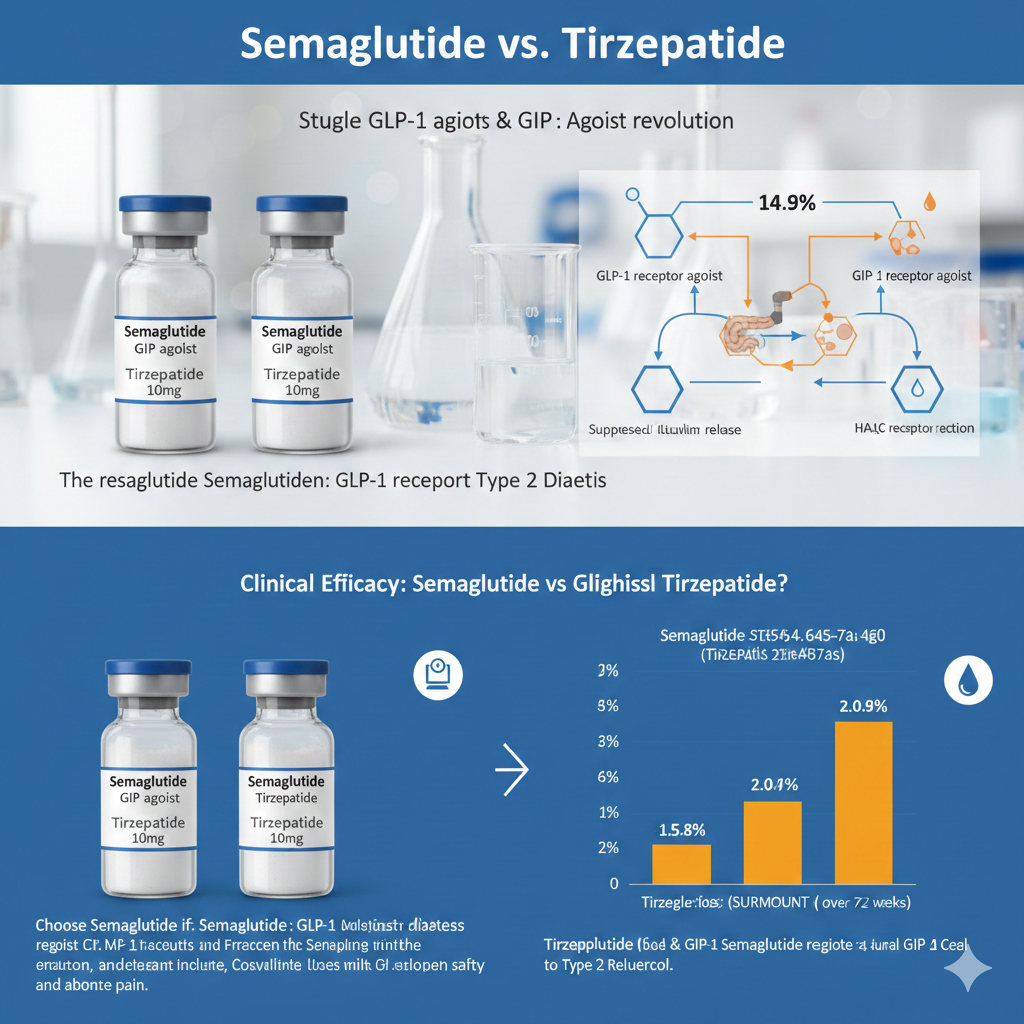
Tirzepatide: The GLP-1 and GIP Dual Agonist
Tirzepatide is the first-in-class dual GLP-1 and GIP receptor agonist, often referred to as a “twincretin.” It combines all the benefits of GLP-1 agonism with the added effects of Glucose-dependent insulinotropic polypeptide (GIP).
GIP’s role includes:
- Improved Glucose Tolerance: Directly enhancing the body’s ability to process sugar.
- Potentiating Insulin Secretion: Working alongside GLP-1 for a stronger effect.
- Direct Impact on Fat Cells: Some research suggests GIP may play a role in fat cell metabolism and differentiation.
This synergistic action gives Tirzepatide 10mg an edge in both weight loss and glycemic control studies.
Clinical Efficacy: A Head-to-Head Comparison
The clinical trial data has been a major point of discussion in the research community.
Weight Loss Results
- Semaglutide (STEP Trials): Showed an average body weight reduction of approximately 15% over 68 weeks.
- Tirzepatide (SURMOUNT Trials): Demonstrated even more profound results, with average weight reductions reaching over 20%, and up to 22.5% in some cohorts over 72 weeks.
This makes Tirzepatide currently the most effective FDA-approved peptide for weight loss.
Glycemic Control for Type 2 Diabetes
Both are highly effective, but Tirzepatide consistently showed superior reductions in HbA1c levels compared to Semaglutide in head-to-head trials. This is largely attributed to the additional GIP mechanism.
Key takeaway: While both are excellent, Tirzepatide’s dual-action often provides a more robust response in both weight loss and glucose management.
Side Effects & Safety Profile
Both peptides share similar gastrointestinal side effects, which are generally mild-to-moderate and tend to decrease over time as subjects adjust to the dosage.
- Common Side Effects: Nausea, vomiting, diarrhea, and constipation.
- Mitigation: Gradual dose escalation is crucial for minimizing these effects in research protocols.
Researchers should always adhere to strict safety protocols.
Which Peptide is Right for Your Research?
Choosing between Semaglutide and Tirzepatide depends on your specific research goals:
- Choose Semaglutide if: You are focusing on GLP-1 specific mechanisms, require a well-established baseline, or have budget constraints where a highly effective single-agonist is sufficient. It’s an excellent choice for general weight management and diabetes studies.
- Choose Tirzepatide if: Your research aims to achieve the highest possible weight loss efficacy, superior glycemic control, or you are exploring the synergistic effects of GLP-1 and GIP on metabolic pathways. It represents a step forward in obesity pharmacotherapy.
For the absolute cutting-edge, consider the “Triple G” agonist Retatrutide, which adds Glucagon for even greater metabolic impact.